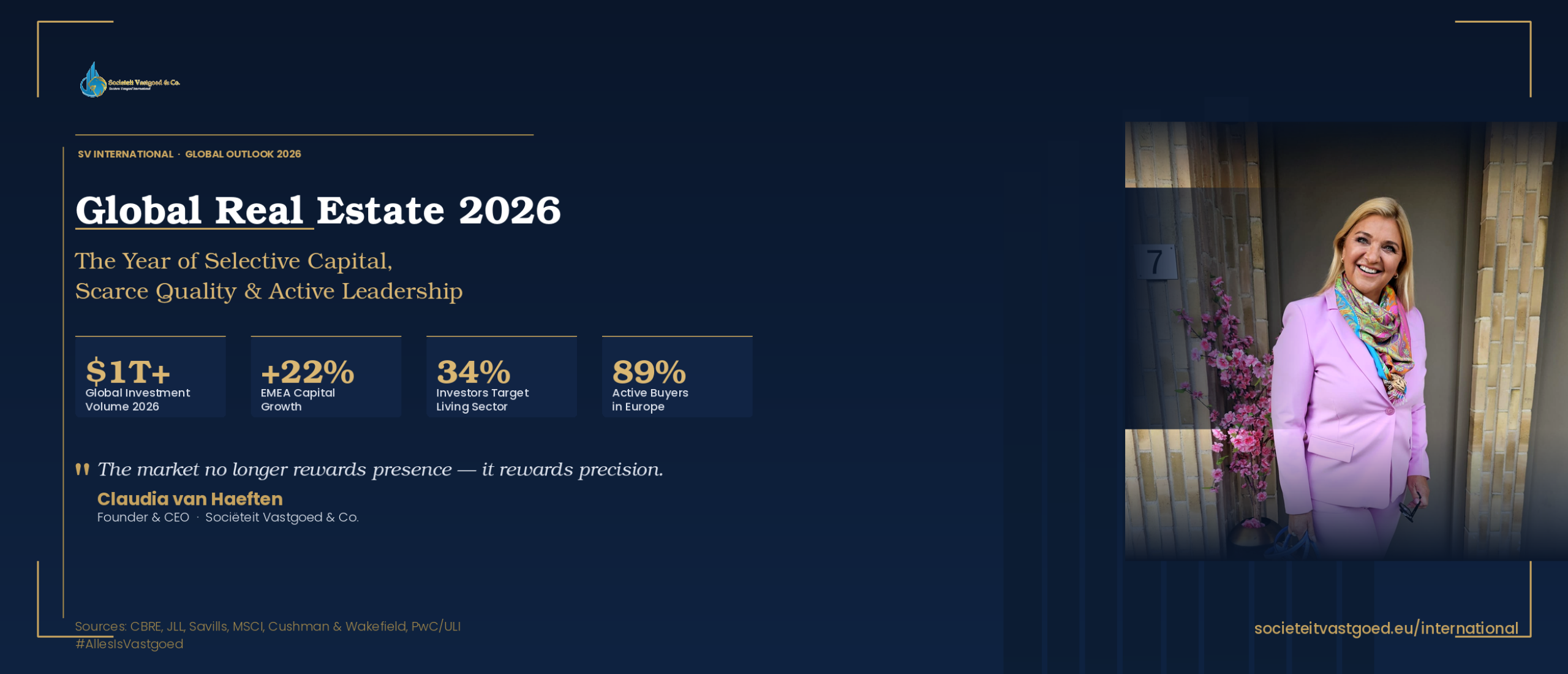

Global real estate 2026: the year of selective capital, scarce quality and active leadership
There are years in which real estate speaks loudly.
And there are years in which it speaks quietly — but only to those willing to listen carefully.
2026 is one of those years.
Anyone looking only at headline investment volumes will see recovery. Anyone looking more closely will see something more profound: global real estate is not returning to the old normal. It is moving into a new regime in which capital is more selective, quality is scarcer, and decision-making has become far more active. The market is now less about participation and more about precision; less about ownership and more about control. That reading is consistent across the latest outlooks from CBRE, JLL, Savills, MSCI, Cushman & Wakefield, and PwC/ULI. (CBRE Media Assets)
The first conclusion is straightforward: capital is returning, but it is behaving differently.
Savills forecasts that global real estate investment turnover will exceed US$1 trillion in 2026, roughly 15% above 2025, with EMEA expected to post the strongest relative growth at 22% to US$300 billion. JLL describes the same shift with more caution: capital markets strengthened in the second half of 2025 and momentum is expected to build through 2026, while lender appetite continues to broaden across sectors. This is not exuberance. It is a more disciplined willingness to transact. (Savills)
Europe captures that in-between phase particularly well: recovery, but without euphoria. CBRE says the European rebound is still in an early stage, with deal volumes still around 40–45% below peak levels. Savills estimates that European real estate investment volumes in Q1 2026 will reach around €52 billion, up 6% year-on-year, and forecasts approximately 16% growth for full-year 2026. MSCI remains the most sober voice: opportunities to re-enter the market are emerging as pricing adjusts and capital markets stabilize, but liquidity across major global metros remains below long-run averages. In other words, the market is improving — just not in a straight line. (cbre.com)
That distinction from previous cycles matters.
CBRE explicitly notes that returns in this phase are expected to be primarily income-driven, not fueled by aggressive yield compression or cheap debt. Long-term rates remain elevated, which makes stock selection and proactive asset management central to performance. In practical terms, the market is becoming far less forgiving of mediocrity. Owning many assets is no longer enough; owning the right assets — and managing them actively — is what matters. (CBRE Media Assets)
So where is capital actually landing?
In Europe, the answer is remarkably clear. CBRE states that living has now become the continent’s largest investment sector, and in its 2026 European Investor Intentions Survey, 34% of respondents named living as their primary target sector. That preference is not cyclical fashion. It reflects structural housing shortages, demographic pressure, and the appeal of more predictable income streams. CBRE also expects the structural supply-demand imbalance in living to continue supporting rental growth, while Europe’s appeal to international students should keep driving demand for PBSA. (CBRE Media Assets)
Outside Europe, capital is also moving with discipline rather than impulse. In Asia Pacific, CBRE reports that net buying intentions for 2026 rose to 17%, up from 13% in 2025. Most notably, offices became the preferred sector for the first time in six years, ahead of industrial and living. The reason is not sentimentality but fundamentals: stronger leasing activity, more constrained supply, and improving rental growth expectations in markets such as Australia, Japan, and Singapore. Tokyo remained the top cross-border destination for the seventh consecutive year. (cbre.com)
That office repricing deserves particular attention in Europe as well, because it says so much about the nature of this cycle. The story is not that “offices are back.” The real story is that prime quality has become scarcer and therefore more valuable. Reuters reported, citing Cushman & Wakefield research, that European office construction has fallen to its lowest level in a decade even as demand for top-quality space remains strong. By the end of 2025, only 10.1 million sq ft was under construction, while demand in London alone exceeded 11 million sq ft. Reuters also reported a Grade A vacancy rate of 3.5%, compared with an overall European office vacancy rate of 9.8%. Cushman separately said European office investment reached €52 billion in 2025, up 14% year-on-year. (Reuters)
This is why the office market is no longer simply about space.
It is increasingly about quality, energy, talent, and corporate identity. JLL frames the broader point well: shortages of top-quality space are intensifying across property types, while “experience” is becoming a new value driver. For leaders, that means the best square metres are no longer a commodity. They are a competitive advantage. (JLL)
Logistics and data infrastructure remain central, but the narrative there has also matured. CBRE expects only moderate improvement in European logistics take-up in 2026, with prime rental growth slowing further as occupiers become more cost-sensitive. The growth story is less about footprint expansion and more about upgrading facilities. In data centres, the opposite dynamic applies: CBRE expects European vacancy to compress to a record low of 6.5% by the end of 2026, driven by AI-related demand but constrained by grid bottlenecks and power availability. MSCI adds an important layer: assets such as data centres increasingly sit at the blurred boundary between real estate and infrastructure, making micro-location, energy access, cooling, and technical viability decisive. (CBRE Media Assets)
At the same time, this is not simply a story of sector rotation. It is a story of changing risk perception. PwC/ULI found that 70% of European real estate leaders now view deglobalization as a key concern, up from 31% the year before. In the same study, 75% reported already using AI or machine learning in real estate activities, compared with 51% a year earlier. Climate risk is also moving up the capital stack: 83% said it is the second most important ESG credential for accessing finance, after energy efficiency. These are no longer peripheral issues. They are shaping how capital prices, lends, and selects. (PwC)
This combination of geopolitics, technology, and financing explains why 2026 is, above all, a market of discipline. Savills still ranks economic and fiscal conditions as the leading global theme, but now places technology second, propelled by AI adoption. CBRE’s Europe survey reflects the same shift in investor behaviour: 89% of respondents intend to maintain or increase buying activity in 2026, while 69% are pursuing alternatives, up 7 percentage points from the year before. London, Madrid, Warsaw, Barcelona, and Milan rank among Europe’s most attractive cross-border markets. (Savills)
And yet this is not only a story about capital.
It is equally a story about leadership. In a market where debt is available but not cheap, where demand is returning but unevenly, and where data is abundant but interpretation remains scarce, competitive advantage shifts from scale to sharpness. JLL argues that the operating environment is becoming more stable in 2026, but also more complex because economic, technological, and social forces are converging. MSCI makes the investment case plainly: allocators will need a far more granular view of risk-adjusted returns because broad asset-class labels no longer explain enough. The era of lazy allocation is ending. (JLL)
So the central question is no longer: is recovery coming?
The real question is: who can still distinguish, prioritize, and execute within that recovery?
For leaders across real estate, the implication is clear.
Not more information, but better interpretation.
Not faster movement, but more deliberate positioning.
Not consensus-following, but real direction-setting.
That is precisely where Sociëteit Vastgoed International intends to play its role. Not by speaking louder than the market, but by reading the market more carefully. Not by hiding behind uncertainty, but by connecting knowledge, capital, policy, and practice. At a time when many parties are still searching for certainty, we believe relevance is built on three things: evidence-based market intelligence, access to the right decision-makers, and the willingness to translate international developments into concrete strategic steps.
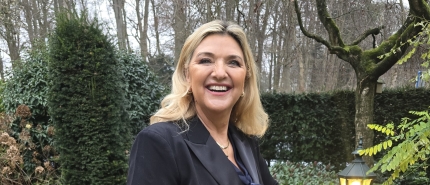
A personal note from Claudia van Haeften
"As founder, I see every day how deeply this market needs direction, nuance, and genuine connection — especially now. Real estate is no longer just a world of buildings and spreadsheets; it is a world of choices, trust, timing, loyalty and leadership.
That is why, together with Sociëteit Vastgoed International, I remain committed to bringing decision-makers together and moving them forward with insight that is accurate, interpretation that matters, and a network that creates momentum".